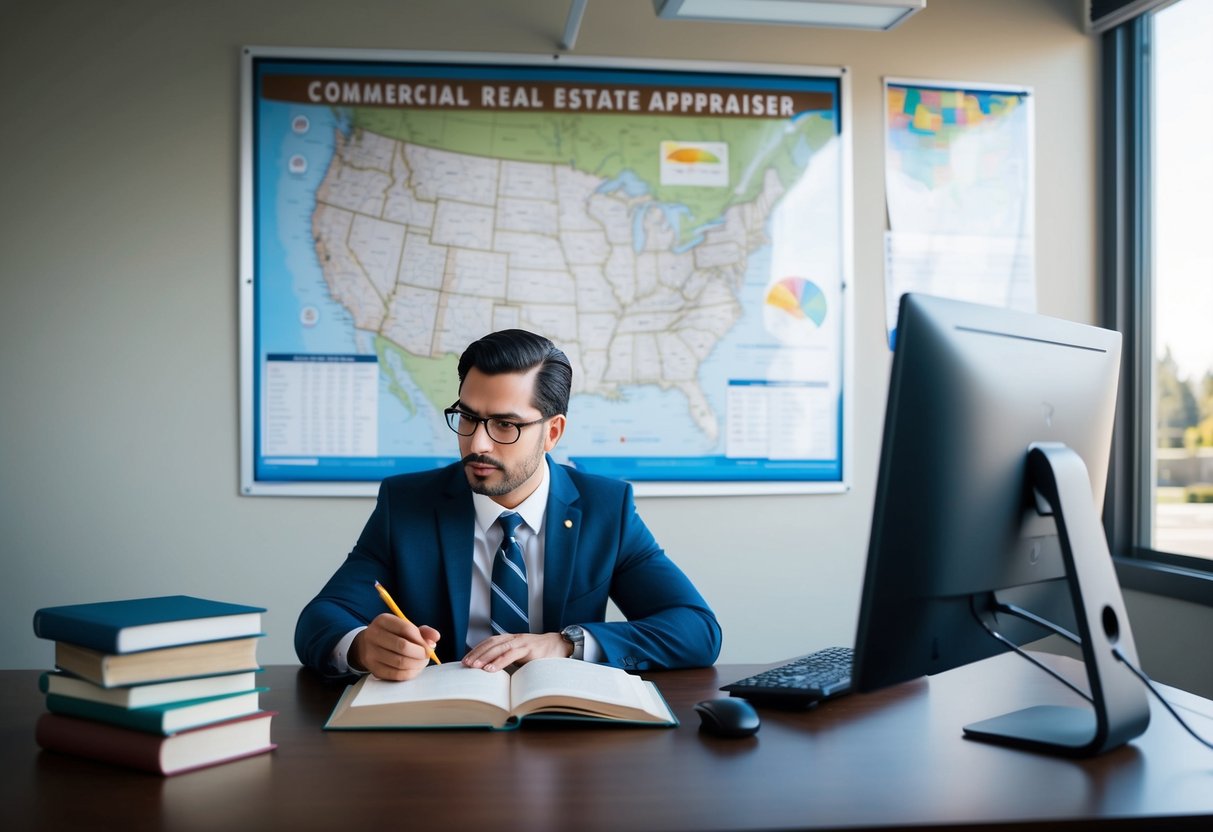
Navigating the Application Process for the California Commercial Real Estate Appraiser Examination: A Step-by-Step Guide

Understanding the California Real Estate Appraisal Licensing Process

The journey to becoming a certified appraiser in California requires meeting specific requirements and gaining the right qualifications along the way. We will explore the eligibility for trainee appraisers, the path towards becoming a licensed residential appraiser, and how to advance to a certified general appraiser.

Eligibility Requirements for Trainee Appraisers

To start as a trainee appraiser, we must first ensure we meet certain requirements. Key qualifications include a minimum of 18 years of age and legal residency in the U.S. The Bureau of Real Estate Appraisers requires us to complete specific education courses, totaling 150 hours of appraiser education.

A supervisory/trainee appraisers course is essential. This course introduces us to important concepts, regulations, and guidelines necessary for appraisal practice.

We must also pass background checks. This step ensures that we have no criminal history that could affect our credibility as an appraiser. Once we meet all these requirements, we can apply for a trainee license.

Path to Becoming a Licensed Residential Appraiser

After gaining experience as a trainee, we can move towards becoming a licensed residential appraiser. In this stage, we need more education, including college coursework focused on real estate appraisal. A total of 200 creditable hours of appraiser-specific education is necessary.

We also need practical experience, which involves 2,500 hours of appraisal work over at least 2 years. This helps us develop critical skills through supervised fieldwork.

Finally, passing the Licensed Residential Appraiser examination is required. This exam tests our understanding of residential appraisals and ensures we can apply knowledge effectively. The exam covers important aspects, including property valuation and real estate law.

Advancing to a Certified General Appraiser

To achieve the status of a certified general appraiser, we must complete advanced education and gain an increased level of expertise. This requires an additional 300 hours of qualifying education and a bachelor’s degree in most cases.

Experience is crucial. We must log 3,000 hours of appraisal work within 30 months, with a minimum of 1,500 hours covering non-residential properties. This experience must be diverse to prepare us for complex evaluations.

Passing the Certified General Appraiser exam is the final step. It includes more comprehensive topics, such as commercial properties and intricate valuation methods. With dedication and the correct qualifications, we can reach this advanced level.

Application and Education for California Commercial Appraisers

A commercial appraiser studying at a desk with California real estate materials and an application form

To become a commercial real estate appraiser in California, we must follow several steps. These include submitting an application, completing required educational coursework, and undertaking specialized training.

Initial Application Submission

First, we start with the initial application. This involves applying for a Trainee Appraiser position. We need to fill out the necessary forms and pay any applicable fees to the California Bureau of Real Estate Appraisers. The application requires personal information and education background. It’s essential to ensure all details are accurate.

We should also be prepared to undergo a background check. This involves fingerprinting; approval is necessary before we can proceed to the next steps. Keeping track of deadlines and detailed submission guidelines helps avoid application delays or rejections.

Qualifying Education and Required Coursework

Next, we focus on our education. Successful completion of certain courses is a must. Content includes Basic Appraisal Principles, Basic Appraisal Procedures, and Residential Market Analysis. We also cover Highest and Best Use and various income approaches.

Our educational path requires a mix of classroom and practical learning. Subjects such as Residential Sales Comparison and Residential Report Writing play a role, along with Case Studies to understand real-world applications. Complying with these requirements is crucial as they lay the groundwork for advanced levels

Education certificates must be obtained from approved providers. These confirm the completion of our courses and prove eligibility for advancing our appraiser license. Staying organized with our documents will make the process more manageable.

National USPAP Course and Specialized Training

Completing the National USPAP Course is mandatory. It covers the Uniform Standards of Professional Appraisal Practice. This course is important for understanding ethical considerations and maintaining integrity in our work.

We may also need specialized training, depending on the area of focus. For instance, topics such as Cultural Competency and Elimination of Bias are included to ensure well-rounded skills. These elements focus on fairness and unbiased judgment.

Training encompasses not just traditional classroom environments but also real-world appraiser experiences. Through diverse learning methods, we gain essential skills and knowledge needed to handle our responsibilities effectively.

Professional Standards and Practical Experience

To become a California Commercial Real Estate Appraiser, we navigate through specific professional standards and garner practical experience. This journey involves gaining appraisal experience, understanding detailed reports, and maintaining strict ethics to ensure competency and fairness in the appraisal field.

Gaining Appraisal Experience

We start by acquiring hands-on experience under a supervisory appraiser. This step is vital as it lays the groundwork for becoming a skilled appraiser. Trainee appraiser licenses allow us to gain supervised hours, refining our skills in assessing property value in various real estate sectors.

Practical exposure includes working with both residential and commercial properties. By working across these areas, we develop a more comprehensive skill set. We also familiarize ourselves with industry norms and expectations, ensuring we’re prepared for the certification examination. Engaging in diverse appraisal tasks helps us broaden our knowledge base and improve our analytical skills.

Understanding Appraisal Reports and Valuation

Appraisal reports are the core documents summarizing our findings. We must be proficient in creating detailed, clear reports that adhere to appraisal standards. These documents include crucial elements like property valuation, condition assessments, and potential feasibility analyses.

Knowledge in report writing ensures that we accurately present our conclusions for various audiences, including clients and courts, especially in litigation contexts. We delve into reports to practice the required precision and clarity. Developing skills in reading and writing these reports is crucial for effective communication within the real estate appraisal industry.

Ethics, Bias, and Competency in Appraisal

Ethics forms the backbone of our profession. We strive to conduct unbiased appraisals, applying cultural competency in all our evaluations. Recognizing and eliminating bias is essential for integrity and trust in our industry.

Competency involves continual learning and adherence to ethical standards. By valuing ongoing education, we maintain high standards and ensure our work remains credible and respected. We commit to these principles, as they guide us in providing fair, accurate property assessments. Our dedication to ethical practices helps us consistently serve our clients and maintain public trust.

Key Regulations and Guidelines for the California Commercial Real Estate Appraiser Examination: Essential Insights

California Real Estate Appraisers Certification Requirements

In California, becoming a certified real estate appraiser requires meeting specific educational, training, and licensing standards. These involve understanding state regulations and adhering to both state and national guidelines. Familiarity with procedural compliance and cultural competency is also essential.

A stack of official documents and a pair of glasses on a desk, with a ruler and a pen next to them

Education and Training Standards

To start, we must complete specific education courses. The requirements include at least 150 hours of education for the Trainee Appraiser license. Courses cover topics like basic appraisal principles, procedures, and the Uniform Standards of Professional Appraisal Practice (USPAP).

For advanced licenses, more education is required. For example, a Certified Residential Appraiser needs 200 hours. Experience plays an important role. Besides education, completing between 1,000 to 2,500 hours of experience is mandatory, depending on the type of certification we pursue.

AQB and State Licensing Requirements

California follows guidelines set by the Appraiser Qualifications Board (AQB). One of our key steps is passing the AQB-approved exam required for the appraiser license. The state also demands a background check. Title XI’s deep focus ensures each of us meets these standards.

Our licensing is split into levels. There’s the Trainee Appraiser for entry-level, then Licensed Residential, Certified Residential, and Certified General. Each level has its own education, exam, and experience requirements. It’s essential we comply with both AQB and state-specific laws to earn and maintain our license.

Procedural Compliance and Cultural Competency

Understanding and following correct procedures is crucial for a real estate appraiser. We must ensure our work complies with all legal guidelines, maintaining objectivity. We can’t underscore enough the significance of cultural competency—part of California’s licensing stipulates training in elimination of bias.

We learn to be aware of and adjust to diverse cultural norms and biases. Proper training prepares us to handle appraising equitably across various properties and communities. Cultural competency helps us maintain fairness in the appraisal process. Compliance with these standards ensures we offer credible and unbiased valuation services.

Appraisal Methodologies and Approaches

In the field of real estate appraisal, it’s important to use various methods to determine property value accurately. We’ll explore key concepts and techniques that appraisers utilize to deliver valid and reliable appraisal reports.

Fundamentals of Appraisal Practices

When conducting property appraisals, we start with basic principles and procedures. Our methodology includes the sales comparison approach, where recent sales of similar properties guide us in setting the value.

We also apply the cost approach, focusing on the cost to rebuild or replace a property, minus depreciation. This is especially relevant for new or unique properties.

The income approach helps us when evaluating income-generating properties. We assess potential income and apply formulae to estimate current market value. Each approach provides us unique insights and is tailored to individual property characteristics.

Specialized Appraisal Techniques

Specialized techniques expand our analytical toolkit beyond general practices. Understanding appraisal theory helps us apply foundational knowledge with precision.

Residential market analysis involves studying neighborhood dynamics and market trends to understand influences on property value. We factor in local economic, social, and governmental trends.

Advanced methodologies may involve statistical models and technology-based assessments, using software and digital tools for more accurate predictions.

By employing these specialized techniques alongside the fundamental approaches, we ensure our appraisal reports are comprehensive, accurate, and tailored to meet the unique demands of each property and client. This robust approach allows us to maintain high standards of quality and reliability.

Regulations and Oversight in California Appraisal

Regulations for appraisers in California are detailed and comprehensive. They ensure that appraisers meet specific standards and guidelines. Oversight is primarily managed by state and national bodies to maintain quality and consistency.

California Bureau of Real Estate Appraisers Role

The California Bureau of Real Estate Appraisers (BREA) is responsible for licensing and regulating appraisers in the state. Our task is to ensure appraisers meet the standards set by both state and federal laws. We examine candidates thoroughly, assessing appraisal experience through various hands-on and educational requirements.

We implement the Supervisor/Trainee Model to mentor new appraisers, providing structured guidance. Moreover, BREA implements guidelines from the Appraisal Subcommittee (ASC) under FIRREA to align state standards with national policies. Compliance with these standards ensures appraisers can adequately perform in different settings.

National and State Law Compliance

Appraisers in California must comply with national and state laws. The Uniform Standards of Professional Appraisal Practice (USPAP) is a key guideline, and all practicing appraisers must complete the National USPAP Course. This course ensures we are up-to-date with the latest ethical and performance standards.

Moreover, the introduction of Practical Applications of Real Estate Appraisal (PAREA) allows for modern learning experiences through practical applications and digital tools. This supplements traditional methods, preparing us for dynamic challenges in the field. Compliance with both state and national standards guarantees that our appraisals are both valid and reliable across different contexts.

Understanding the Content and Format of the California Commercial Real Estate Appraiser Examination: A Comprehensive Guide

Professional Standards and Licensing

In California, commercial real estate appraisers must follow specific professional standards and meet licensing requirements. Understanding the role of the Bureau of Real Estate Appraisers and the qualifications needed is essential for those pursuing this career.

Bureau of Real Estate Appraisers (BREA) Overview

The Bureau of Real Estate Appraisers (BREA) regulates appraisers in California. BREA ensures that all licensed appraisers meet the state’s professional standards. Established under state law, BREA’s mission is to protect public interest by regulating and promoting licensed real estate appraisers.

BREA oversees licensing for commercial appraisers and monitors compliance with state and federal laws. Key responsibilities include issuing licenses, investigating complaints, and ensuring that appraisers follow established guidelines. We rely on BREA to maintain market confidence and guarantee that appraisals are performed ethically and accurately.

In addition to these duties, BREA provides educational resources and updates on regulations. Its role is crucial in maintaining a fair and transparent appraisal process.

Licensing Requirements for Commercial Appraisers

To become a licensed commercial real estate appraiser in California, we must fulfill specific licensing requirements. An appraiser license is mandatory for those evaluating commercial property values in the state.

Prospective appraisers start with a Trainee License. To advance, an Initial License must be obtained, followed by higher levels like the Certified General License. Each level requires passing relevant exams and gaining experience.

For those from other states, a Reciprocal License might be available. This allows licensed appraisers from some states to work in California. All appraisers must meet federal standards set by the Appraisal Subcommittee.

Education and Experience Criteria

Education and experience are key to obtaining an appraiser license. Applicants must complete courses approved by BREA. The curriculum covers essential topics such as ethics, market analysis, and legal aspects of appraising.

A college degree is typically required for higher license levels. We must also acquire relevant work experience under supervision, where we apply knowledge in real-world scenarios. The number of required hours varies depending on the license level.

Aspiring appraisers should plan their educational path carefully. The process can take several years, requiring dedication. Meeting these criteria is crucial for building a successful career in commercial real estate appraisal.

Commercial Appraisal Methodology

A person studying a textbook on commercial real estate appraisal, surrounded by charts, graphs, and reference materials

We will explore various appraising techniques for commercial real estate, emphasizing process understanding, income approaches, and market analysis.

Understanding the Appraisal Process

Appraisal practice involves steps that help in determining a property’s market value. We first gather data about the property, such as location, size, and current market trends. Knowing these key details allows us to conduct thorough property research. Basic appraisal principles and procedures ensure consistency and reliability in our evaluations.

Next, we analyze the property’s features and the surrounding area. This helps to identify similar properties that have been sold recently. Documentation and communication are crucial. It is important to maintain records and present findings clearly.

Income Approaches to Property Valuation

The income approach helps us determine the value of commercial properties by looking at the income they generate. This method involves calculating the potential income from renting or leasing the property. We consider factors like current rental rates, vacancy rates, and operating expenses.

We use techniques like the direct capitalization approach, where we apply a capitalization rate to the net operating income. This helps in predicting the property’s value based on income generated. Another technique is the discounted cash flow analysis, which projects potential future cash flows and discounts them to present value.

Sales Comparison and Market Analysis

The sales comparison approach identifies a property’s value by comparing it with similar properties recently sold in the area. We select comparables based on size, location, and condition. Adjustments are made for differences in features, amenities, and market conditions.

Market analysis helps us understand trends affecting property values. We observe factors like demand and supply, economic conditions, and interest rates. These elements provide insight into how properties are valued and help us make informed appraisals. This ensures our evaluation reflects current market conditions accurately.

Ethics and Competency in Appraising

A person studying a thick textbook on real estate appraising, surrounded by reference materials and a computer, with a focused and determined expression

Ethics and competency are vital in commercial real estate appraisal. We must focus on cultural competency and eliminate biases to maintain high appraisal standards. Embracing new technology is crucial for effective appraising.

Cultural Competency and Elimination of Bias

Cultural competency requires us to understand the diverse backgrounds of property owners. By recognizing and respecting these differences, we can make fairer appraisals. Eliminating bias ensures we don’t let stereotypes affect our judgment.

To achieve this, we adhere to strict appraisal standards that promote fairness. We educate both trainee appraisers and certified commercial real estate appraisers on identifying and eliminating biases. This involves continuous training and open discussions about diversity.

Promoting diversity in our field strengthens our ability to serve a wide-ranging client base. It leads to greater trust and accuracy in our appraisals. Recognizing diversity is key to maintaining ethical standards.

Advancing Technological Tools in Commercial Appraisal

Technological advancements have transformed how we conduct appraisals. New tools help us assess property values more accurately and efficiently. For instance, software applications allow us to analyze market trends quickly.

This technology is beneficial for both trainee and certified appraisers. It provides us with up-to-date information and insights. By leveraging these tools, we enhance our competency in commercial real estate appraisal.

To stay current, we regularly update our skills with these tools. Training programs focus on integrating technology into our daily practices. This ensures we deliver precise and timely appraisals for our clients.

Tips for Preparing for the California Commercial Real Estate Appraiser Examination: Essential Strategies for Success

Understanding Appraiser Certification Requirements

A desk with study materials, a computer, and a stack of books. A window with sunlight streaming in, illuminating the room

To succeed in the California Commercial Real Estate Appraiser Examination, we need to grasp the various certification requirements. This involves knowing the qualifications standards, education and experience needs, and important appraisal guidelines.

Overview of Appraiser Qualifications Board and BREA Standards

The Appraiser Qualifications Board (AQB) sets the minimum qualifications for real estate appraisers. It’s crucial for us to follow these guidelines as they ensure we are well-prepared and skilled. The Bureau of Real Estate Appraisers (BREA) in California enforces these standards. They manage the licensing process and ensure that appraisers meet necessary regulations.

Staying informed about AQB and BREA standards helps us in maintaining compliance. This step also lays the groundwork for professional growth. By closely adhering to these guidelines, we position ourselves as competent professionals in the appraisal industry.

Education and Experience Prerequisites

Education and experience are key components for becoming a certified appraiser. We must complete a set number of hours in educational courses recognized by the Appraisal Foundation. Courses cover vital areas like property valuation, market analysis, and appraisal ethics.

Experience requirements involve logging a certain amount of practical work under a certified appraiser’s supervision. Real-world experience allows us to apply theoretical knowledge and develop a robust skill set. Carefully tracking our education and work hours ensures we meet the licensing standards.

Grasping the USPAP and FIRREA Guidelines

Understanding Uniform Standards of Professional Appraisal Practice (USPAP) and Financial Institutions Reform, Recovery, and Enforcement Act (FIRREA) guidelines is essential for compliance. USPAP sets the national standards for appraisal practices. We must regularly update our knowledge of these standards to stay current.

FIRREA guidelines, on the other hand, were established to ensure the reliability of appraisals used in federally related transactions. These guidelines improve our ability to provide precise and credible appraisals. Regular participation in continuing education is crucial for staying updated with changing laws and appraisal practices.

By following USPAP and FIRREA, we adhere to ethical practices and maintain high-quality work standards in the appraisal industry.

Mastering Appraisal Knowledge and Techniques

To succeed in the California Commercial Real Estate Appraiser Examination, we must build a strong understanding of property characteristics, assess different approaches to value, and analyze site valuation principles. Being well-versed in these areas is essential for giving precise and accurate property appraisals.

Property Description and Market Analysis

Understanding the real estate market is vital. We begin by examining properties in detail, focusing on location, size, age, and condition. This property description should be thorough, capturing features that impact value.

For market analysis, we gather data about recent sales, current listings, and local trends. Analyzing this information helps us identify value indications and assess the economic conditions affecting real estate. Proper analysis aids in predicting how property values may shift over time.

Cultural competency is essential. We ensure our analysis is free of bias and considers the diverse needs and backgrounds of people in the market. This awareness allows for more accurate appraisals and satisfied clients.

Understanding Approaches to Value

Sales Comparison Approach involves looking at recent sales of similar properties. We study differences like location and features to adjust and find a fair market value for the subject property.

In the Cost Approach, we use cost information to determine the property’s value by calculating expenses to replace or reproduce it. We need to account for accrued depreciation to get an accurate estimate of the property’s worth.

The Income Approach is crucial for appraising investment properties. Here, we analyze potential income production and consider future earnings. This requires a careful look at rent, occupancy rates, and expense projections.

Together, these approaches provide a comprehensive view of real estate value.

Site Valuation and Highest and Best Use Concepts

Site valuation examines land value separately from improvements. We consider factors like location, access, and zoning restrictions. Knowing this helps us understand the potential and limitations of the property.

The concept of highest and best use is central to appraising. We look for the most profitable, legal, and feasible way to use a property. This ensures we appraise it for what a buyer would most likely pursue.

For both certified general appraisers and certified residential appraisers, mastering these principles aids in delivering accurate appraisals with confidence.

Strategic Exam Preparation Techniques

A person studying at a desk with books, notes, and a laptop. Flashcards and study materials are organized around them, and they appear focused and determined

To excel in the California Commercial Real Estate Appraiser Examination, we need a focused plan and effective study resources. Creating a detailed schedule helps us stay organized and motivated. Using diverse study tools can reinforce knowledge, and structured practice boosts confidence.

Developing a Comprehensive Study Plan

Creating a study plan is crucial for tackling the certification examination. We should start by breaking down the exam topics and organizing our study time. A consistent schedule—perhaps two hours daily—keeps us on track. Flashcards help memorize terms related to appraisal standards, appraiser qualification criteria, and ad valorem.

Regular reviews are essential to reinforce what we’ve learned. Dedicating certain days to review helps us identify weak areas. If we plan for variety, like quizzes and calculations practice, we can make our study sessions engaging and effective.

Effective Study Resources and Practice Methods

Using the right materials makes a huge difference in passing the exam. Textbooks and online courses tailored for licensed residential appraisers and the certified general exam are helpful. Practice exams, available through many platforms, are invaluable for getting comfortable with exam format and time constraints.

Joining study groups connects us with peers facing the same challenges. This enables us to share tips and strategies, boosting our collective confidence. Online forums can help answer questions we might have as we prepare for our appraiser license or license upgrade.

Overview of the Examination Process for Commercial Real Estate Appraisers in California: Essential Guide

Qualifying for Commercial Appraiser Certification in California

A person studying at a desk with books, notes, and a computer, surrounded by charts and graphs related to commercial real estate appraisal

To become a certified commercial appraiser in California, we need clear guidance on the career path, educational background, practical experience, and examination process. These components are essential for success in the real estate market.

Understanding the Career Path

As commercial appraisers, we often start our careers in real estate, gradually specializing through education and experience. The goal is to become a Certified General Appraiser. This designation allows us to appraise all property types.

To reach this level, we can begin as a Licensed Residential Appraiser and gain progressive experience. The Appraiser Qualifications Board helps set the standards for qualifications. Our journey involves understanding these standards and completing the required steps diligently.

Education Requirements

Education is crucial for aspiring commercial appraisers. We must complete a minimum of 300 hours of courses, including basic appraisal principles and procedures. The real estate market is complex, so a thorough understanding of appraisal concepts is essential.

These courses are approved by The Appraisal Foundation and include a range of topics like market analysis, highest and best use, and report writing. Continuing education is necessary to keep our knowledge current as industry standards evolve.

Experience Requirements

We need significant hands-on experience to qualify as a certified general appraiser. Specifically, we must accumulate 3,000 hours of experience over at least 18 months. At least 1,500 of these hours should focus on non-residential properties.

Documenting our work is important as it demonstrates expertise in handling varied appraisal tasks. The real estate market requires us to be versatile, adapting to different property types and scenarios. FIRREA guidelines help ensure consistent, high-quality evaluations by us.

Examination Requirements

The final step is passing the Certified General Appraiser exam. This comprehensive test evaluates our knowledge of all necessary appraisal practices. Topics include the appraisal process, ethics, and standards.

Preparation is key. We should review study guides and practice exams to ensure we are ready. The exam tests not only our knowledge but our ability to apply what we’ve learned in real-world scenarios. Passing this exam verifies our qualifications as skilled professionals in the field.

Preparation for the State Certification Exam

Passing the State Certification Exam for commercial real estate appraisers requires careful planning and study. We explore important areas like understanding the USPAP principles, valuable study materials, and creating a personalized study plan.

Review of USPAP and its Principles

Understanding USPAP (Uniform Standards of Professional Appraisal Practice) principles is crucial for success in the certification exam. USPAP provides guidance on appraisal practices and ethics. It includes standards related to the sales comparison approach, cost approach, and income approach, vital for accurate property assessments.

To ensure we’re prepared, we should consider taking the National USPAP Course or National USPAP Update Course. These courses cover important topics and offer insights into the expectations and standards required in the exam. Successfully completing the course will provide us with a Course Completion Certificate, adding to our credentials.

Study Materials and Resources

Choosing the right study materials is key to preparing effectively. It’s advisable to use resources published by the Appraisal Foundation, which offers comprehensive guides on appraisal standards. We should also explore textbooks on real estate appraisal, practice exams, and flashcards to reinforce our learning.

Using a mix of study tools like online courses, workshops, and study groups can help solidify our knowledge. Seeking out practice exams specifically for the Certified General Appraiser Exam can give us a feel of the actual testing environment and subjects covered.

Developing a Study Plan and Schedule

Creating a structured study plan is essential to cover all topics thoroughly. We should first take stock of the topics and decide how much time to allocate to each. It’s helpful to prioritize areas where we feel less confident, allowing extra time for those topics.

Setting a daily or weekly study schedule helps us stay on track. It’s a good idea to set specific goals for each session, like completing a chapter or taking a practice test. Study tips like taking breaks, reviewing notes regularly, and spacing out study sessions can enhance our retention and understanding.

In conclusion, thoroughly reviewing USPAP principles, using the right study materials, and adhering to a well-structured study plan will greatly enhance our chances of success on the certification exam.

The Appraisal Examination Process

A commercial real estate appraiser reviewing property documents and conducting site inspections

The appraisal examination process for commercial real estate appraisers in California involves various stages, from exam day logistics to post-exam activities. Staying informed about each part can significantly impact success. It is crucial to employ smart strategies during the exam and be prepared for next steps after the exam results are available.

Overview of the Examination Day

On the day of the examination, it’s essential to arrive early. This allows us to manage any last-minute anxieties and ensure we’re set. Our tasks will include verifying identity with appropriate identification, such as a driver’s license. The exam typically comprises multiple-choice questions focusing on areas like real property and site valuation.

During the exam, time management is key. This ensures we have ample time to review calculations and complex questions. Familiarity with the exam format, which aligns with the National Uniform Licensing and Certification Exam, can foster confidence. We should also remember that cultural competency and elimination of bias can enhance our understanding of questions on the certified general license and commercial appraiser sector.

Effective Test-Taking Strategies

Successful test-taking starts with quality preparation. Using flashcards aids in retaining key concepts related to appraiser qualification criteria. Practicing past papers helps identify areas requiring more focus, while attending review sessions with an AQB certified USPAP instructor can clarify doubts.

During the exam, we should tackle questions we’re confident about first. This boosts morale and ensures we aren’t stuck on tough questions longer than needed. It’s helpful to note that the pass rate for the exam reflects consistent, dedicated study efforts.

Keeping notes well-organized helps during last-minute reviews. Also, ensuring we have enough rest prior to the exam aids in concentration and recall during the test.

After the Exam: Next Steps

Upon completing the exam, patience is crucial as results can take some time. Once results are received, understanding whether we’ve passed or need to retake can impact our professional development path. For those who pass, we can seek our appraiser license or specific certifications like the certified residential appraiser.

If retaking is necessary, we should evaluate what went wrong and adjust our study plan. Joining a professional development program and accumulating required continuing education hours every CE cycle, as mandated by the Bureau of Real Estate Appraisers, helps us stay current.

Finding an appraiser who successfully navigated this process can provide valuable insight. Engaging with fellow licensed appraisers offers networking opportunities and mentorship, paving the way to becoming a certified commercial appraiser.

Building a Strong Foundation in Real Estate Appraisal Education: Key Insights and Best Practices

Fundamentals of Real Estate Appraisal Education

A modern classroom with a whiteboard, desks, and chairs arranged neatly. A stack of textbooks sits on a table in the corner

To become skilled in real estate appraisal, it’s essential to grasp both principles and procedures, as well as education and licensing requirements. Knowledge in these areas lays a strong foundation for any appraiser’s career.

Understanding Appraisal Principles and Procedures

In real estate, appraising involves estimating a property’s value. This requires learning basic appraisal principles like market value, price, and cost. These concepts help determine what a property is worth in different conditions.

Basic appraisal procedures focus on methods and approaches to evaluating properties. In practice, these might involve the sales comparison approach, cost approach, and income approach. Each method is applicable in different situations, so understanding when to use which method is crucial for accurate appraisals.

Key Education and Licensing Requirements

Education for appraisers begins at an accredited college or university. Coursework often includes real estate markets, valuation techniques, and ethics. We aim to build a solid understanding as future appraisers.

To practice, there’s a need for licensing and certification. This includes becoming a trainee appraiser, then advancing to licensed residential, certified residential, or certified general appraiser. Passing the National Uniform Licensing and Certification Exam is a vital step in this process.

Compliance with education and testing ensures we not only meet industry standards but are also well-prepared to handle real-world appraisals, fostering trust and credibility in our professional endeavors.

Professional Development and Continuing Education

Continuing education is vital for real estate appraisers seeking to enhance their careers and maintain compliance. Through learning opportunities, like the 15-hour National USPAP Course, we can deepen our expertise and stay up-to-date with industry standards.

Advancing Your Appraisal Career

To move forward in our appraisal careers, it’s important to engage in consistent learning. Courses and webinars, offered by platforms like McKissock Learning, provide a range of topics, from valuation to business management. Electives are available to help us explore different areas and specialties.

Participating in these programs can increase our skills and potentially our income. The real estate appraiser salary can vary based on experience and educational achievements, and continued learning offers pathways to supervisory roles, enhancing our professional standing and opportunities.

Staying Compliant with USPAP

Adhering to the Uniform Standards of Professional Appraisal Practice (USPAP) is critical for maintaining our certifications. Regular USPAP courses offer the necessary knowledge to keep us compliant. We need to take the 15-hour USPAP course and other required credit hours periodically.

Online options are available, making it easier to fit courses into our schedule. These courses help us ensure that we’re meeting standards and fulfilling our roles responsibly. Compliance not only ensures legality but also builds trust with clients and enhances our professional reputations.

Diverse Applications of Real Estate Appraisal Knowledge

A diverse group of buildings, including residential homes, commercial properties, and industrial sites, with varying architectural styles and sizes, surrounded by open land and natural landscapes

Understanding the varied uses of real estate appraisal skills is essential for those in the field. Knowledge gained in this sector extends far beyond simple property evaluations, covering different property types, market analyses, and specialized areas impacted by federal regulations.

Exploring Different Property Types and Market Analyses

When we engage in real estate appraisal, our skills allow us to work with a wide variety of property types, from residential homes to commercial buildings. Each property classification requires different methods and considerations, reflecting its unique circumstances and market conditions.

Residential real estate appraisals often demand an attention to detail, involving property inspections and comparative market analyses. For these tasks, a trainee appraiser might start with basic assessments, learning from a certified residential real estate appraiser.

Market analyses combine insights from economics and real estate law to help us understand property values in different locations. This requires a skilled interpretation of data and trends, ensuring fair evaluations.

Specialized Fields and Federal Regulations

In specialized fields, such as those involving federal land acquisitions, our expertise must align with specific guidelines. The Uniform Appraisal Standards for Federal Land Acquisitions, also known as the Yellow Book, guide appraisers in these cases.

This requires precise adherence to standards, as well as knowledge of real property appraiser qualification criteria. A licensed real estate appraiser can navigate these regulations, providing evaluations compliant with federal expectations.

Appraisal education offers us the foundation for entering these specialized roles, with program content structured to meet the demands of different appraisal contexts. The role of the Appraisal Foundation in setting high standards helps ensure that we can adapt to these varied applications with confidence and competence.

Meeting the Experience Hours Requirement for California Appraiser Licensure: A Comprehensive Guide

Understanding Appraiser Licensure in California

In California, becoming a professional appraiser requires understanding the licensure process and the different types of credentials. We will review the necessary steps to achieve and maintain a license.

Appraiser Licensing Overview

The Bureau of Real Estate Appraisers (BREA) oversees appraiser licensure in California. To become licensed, applicants must meet specific education and experience requirements outlined by the Appraiser Qualification Criteria. These requirements ensure appraisers are well-prepared to assess real estate values accurately.

We begin our journey as Trainee Appraisers, working under the supervision of licensed appraisers. This stage involves gaining practical experience in real property appraisal. Once we complete the required hours, we can apply for higher-level licenses.

Types of Appraiser Credentials

In California, there are different appraiser credentials, including Trainee Appraiser, Certified Residential Appraiser, and Certified General Appraiser. Each credential requires different levels of education and experience.

Trainee Appraisers focus on gaining initial experience. To become a Certified Residential Appraiser, we must complete additional coursework and experience focused on residential properties. For a Certified General Appraiser, more extensive training is needed to appraise all real estate types.

We should remember to renew our licenses regularly and consider obtaining a Reciprocal License if we wish to practice in other states. This ensures we stay up-to-date with California’s real estate laws and maintain our qualifications.

Educational and Experience Requirements

A desk with a computer, calculator, and stack of paperwork. A diploma and certification hanging on the wall. A calendar with highlighted dates

To become a licensed appraiser in California, we must complete specific educational and experience requirements. The process includes approved courses and supervised training periods.

Qualifying Education Pathways

We start with basic education requirements. These include a set of courses like Basic Appraisal Principles, Basic Appraisal Procedures, and Residential Market Analysis. We must take the National USPAP Course to understand the ethical guidelines.

College-level courses in fields such as finance or business may be needed if we aim for higher licensure levels. The Core Curriculum outlines these classes, and each must have approval through the Course Approval Program.

Trainee to Licensed Appraiser Transition

For a Trainee License, completing the required core curriculum is crucial. This includes Residential Report Writing and Income Approaches. Once we finish these, we can work under a Certified Supervisory Appraiser.

Experience requirements vary but are measured in hours of supervised work. Regular reviews of our work help ensure readiness. Continuing education ensures we stay current with industry standards and practices.

Supervisory Appraiser Role and Responsibilities

The supervisory appraiser plays a key role in training. They must have a Certified Supervisory Appraiser designation to oversee our work effectively. Their responsibilities include offering regular feedback and ensuring compliance with regulations.

We need to complete the Supervisory/Trainee Appraisers Course together. This course clarifies the roles and expectations. The guidance provided by the supervisory appraiser is essential for our transition from trainee to licensed appraiser. They ensure that we meet all experience requirements efficiently.

Navigating the Application Process

When working toward California appraiser licensure, it is essential to understand certain components. This process involves submitting an initial application with all necessary documentation. We also need to verify our experience hours and show that we understand California law. Each step is crucial to becoming a licensed appraiser.

Initial Application and Documentation

Our first step is the submission of the initial application. Accurate personal details and educational background must be provided. It is important to include a copy of our bachelor’s degree and any necessary additional coursework.

We gather documents that show our experience in real property appraisals. This includes supervisory appraiser verification. Electronic submissions make the process faster and more efficient. The Appraiser Qualifications Board has guidelines that must be followed precisely.

Experience Hours Verification

Experience hours are crucial. We must complete a combination of mandatory and elective hours. These hours should reflect our work on appraisal reports and demonstrate our competency in appraisal standards.

Verifying these hours requires careful documentation. We need to include signed verification from our supervisory appraiser. Programs like the Practical Applications of Real Estate Appraisal (PAREA) can offer structured opportunities to gain these hours.

California Law Comprehension

Understanding California law is vital. We must learn both federal and state laws and regulations regarding appraisals. A California Law course must be completed successfully. This helps ensure we can comply with regulations.

Training on cultural competency and elimination of bias is essential. We can build awareness about issues that affect the fair assessment of property. Courses on these topics prepare us to meet high standards expected in our practice.

Developing Competency in Appraisal Practice and Principles: Key Strategies for Success

Foundations of Appraisal Practice

In appraisal practice, core principles guide us to uphold integrity, impartiality, and reliability. USPAP (Uniform Standards of Professional Appraisal Practice) provides us with standards that ensure quality and consistency in our appraisals. Let’s explore these principles and our responsibilities deeply.

Understanding USPAP Principles

USPAP serves as the backbone of our field, ensuring all appraisers adhere to uniform standards. Crafted by the Appraisal Standards Board of The Appraisal Foundation, it includes key rules like the ethics rule and competency rule. These rules require us to maintain confidentiality, independence, and avoid conflicts of interest to maintain public trust.

The scope of work rule ensures that we set clear boundaries for each assignment. The jurisdictional exception rule allows flexibility where laws conflict with USPAP. Meanwhile, necessary documentation is governed by the record keeping rule. Each element ensures we’re consistent and reliable in our practice.

Roles and Responsibilities of Appraisers

Our role extends beyond evaluating properties. We have vital responsibilities, including adhering to the ethics and competency rules. Upholding these principles promotes objectivity and impartiality, which are central to our profession. This includes conducting thorough research to provide accurate valuations.

Keeping up with ongoing education is crucial to maintaining our competency. We must ensure our work aligns with current guidelines and practices set by The Appraisal Foundation. By doing so, we not only protect the profession’s integrity but also assure clients of our dedication to quality and reliability. This commitment builds trust with the public and strengthens our field.

Advancing Appraisal Professionalism

A group of professionals engaged in a discussion, surrounded by books and reference materials, with charts and graphs displayed on a nearby screen

To enhance professionalism in appraisal practices, we focus on education, critical review services, and adherence to standards. These elements ensure that appraisers maintain high-quality practices and meet industry expectations.

Commitment to Continuing Education

Continuing education is crucial for appraisers. It helps us stay updated on market trends and valuation techniques. Many organizations offer courses to ensure we meet industry standards. Regular training sessions for personal and business property appraisers allow us to refine our skills.

We participate in workshops and certification programs. These activities broaden our knowledge and understanding of the appraisal process. By engaging in lifelong learning, we enhance the value we offer to clients seeking appraisal services.

Strengthening Appraisal Review & Advisory Services

Appraisal review is a key part of maintaining professionalism. It ensures that our work meets technical, ethical, and professional standards. By rigorously evaluating appraisals, we can provide credible advisory opinions.

Review services help in identifying areas for improvement. They encourage us to adopt best practices and innovative methods. For mass appraisal and business appraisers, reviews provide an opportunity for feedback. This feedback is valuable for refining processes and improving overall accuracy and reliability.

Adhering to Performance Standards

Following established performance standards is vital in promoting trust and confidence. Standards guide our actions and decisions, ensuring consistency and fairness. For personal property or business property, adhering to valuation standards is non-negotiable.

We commit to following guidelines set by recognized appraisal organizations. These standards help us produce objective and reliable appraisals. They ensure our appraisal services are transparent and trustworthy. By aligning with these standards, we uphold the integrity of our profession.

Regulatory Compliance and Appraiser Qualifications

A desk cluttered with appraisal textbooks, a computer displaying regulatory guidelines, and a wall covered in framed certificates and licenses

Ensuring we meet current regulations and qualifications is key to maintaining the standards of the appraisal profession. Navigating federal oversight and keeping up with state certification is crucial for all real property appraisers. These areas provide essential frameworks for appraisers and help ensure competency in practice.

Federal Oversight and USPAP Updates

Federal regulations help maintain quality within the appraisal profession. The Financial Institutions Reform, Recovery, and Enforcement Act (FIRREA) plays a vital role here. This legislation requires conformity to appraisal standards and ensures that appraisers operate within specific guidelines.

The Uniform Standards of Professional Appraisal Practice (USPAP) is updated regularly to reflect changes in the industry. Staying current with these updates is essential. Appraisers are encouraged to take the USPAP update course, which offers guidance and acts as a reference manual.

Incorporating these changes into our appraisal practices ensures compliance and enhances our credibility.

State Certification for Real Property Appraisers

Each state has its own rules concerning appraiser qualifications. Understanding state certification is vital for real property appraisers. States require a level of education and experience, which often involves passing examinations.

State-certified appraisers must adhere to specific state guidelines. Maintaining these certifications ensures appraisers remain qualified and knowledgeable.

Our ongoing education keeps us in line with both state and national standards, reinforcing the importance of certification in upholding the value of the profession.

Navigating the Experience Requirements for California Real Estate Appraisers: A Comprehensive Guide

Understanding California’s Real Estate Appraiser Experience Requirements

In California, aspiring real estate appraisers must meet specific experience requirements to earn their licenses. These involve completing set hours, practical training, and understanding the role of the state’s bureau. We will focus on these pathways and elements to provide a clear picture of what’s needed.

Pathways to Becoming a Real Estate Appraiser

To become a real estate appraiser in California, there are several pathways. We need to earn a credential as either a Trainee, Certified Residential Appraiser, or Certified General Appraiser. Each level has different experience and training requirements.

Trainee Appraisers start by completing a course and finding a supervising appraiser. To become a Certified Residential Appraiser, we need additional education and a set number of experience hours. For a Certified General Appraiser, more extensive experience and education are required. Understanding these pathways can guide our decision on which level to pursue.

Breakdown of Experience Hours

California requires set experience hours to achieve each appraiser level. As Trainees, we need to log hours under supervision for practical learning.

For a Certified Residential Appraiser, we need 1,500 hours of relevant appraisal experience over at least one year. To become a Certified General Appraiser, the requirement rises to 3,000 hours over at least 18 months, with a significant portion in non-residential work. Meeting these requirements ensures we gain the knowledge and skills necessary for professional practice.

Supervised Practical Training

Supervised practical training is crucial for appraisers to gain real-world experience. As a Trainee Appraiser, it’s required to work with a supervising appraiser who guides us through hands-on learning.

We must complete a Supervisory/Trainee Appraisers Course to fully benefit from this training. The course covers important guidelines and methods to ensure that both the trainee and supervisor work effectively together. This practical experience is invaluable in preparing us for obtaining an appraiser license and conducting accurate evaluations independently.

Role of the Bureau of Real Estate Appraisers

The Bureau of Real Estate Appraisers (BREA) plays a significant role in our journey to become a licensed appraiser in California. It oversees the licensing process, ensuring all applicants meet the required standards.

BREA is responsible for maintaining the integrity and quality of appraisals across the state. They provide resources and information, guiding us through the requirements and helping address any questions we may have. Through its oversight, BREA ensures that the real estate appraisers in California adhere to high standards, which builds trust with clients and the public.

California Real Estate Appraisers’ Educational Path

A person studying real estate appraisers' requirements with a map, calculator, and textbooks spread out on a desk

Becoming a real estate appraiser in California requires specific education and ongoing learning. First, we obtain the necessary qualifications, and then we focus on continuous training and addressing new mandates for cultural awareness and bias.

Mandated Education for Licensure

For initial licensure, the Appraiser Qualifications Board sets the education requirements. We start with Basic Appraisal Principles and Basic Appraisal Procedures to form a solid foundation. Following this, we study Residential Report Writing to sharpen our skills in creating detailed appraisals.

We also need to complete a National USPAP Course (Uniform Standards of Professional Appraisal Practice) to ensure we adhere to current practices and ethics. This course teaches us essential appraisal principles. Each educational achievement requires proof through education certificates, making sure we meet all set criteria.

Continuing Education for Appraisers

To maintain our license, continuing education is crucial. We need to engage in regular continuing education courses to stay informed about the latest in real estate appraisal. This ongoing training involves taking the National USPAP Update Course every two years, which keeps us aligned with new standards and regulations.

License renewal is dependent on meeting these continuing education requirements. By gathering education credits, we ensure our skills remain sharp and applicable to the ever-evolving market. Through this, our professional growth stays consistent, preparing us for challenges within the industry.

Special Requirements: Cultural Competency and Bias Elimination

With growing awareness of societal issues, cultural competency and bias elimination are now essential parts of our training. New special courses help us understand diverse communities and approach appraisals with fairness. This education is vital as we continue our work in diverse neighborhoods across California.

By completing these new requirements, we strive to enhance our appraisal practices, ensuring accuracy and respect across all evaluations. These new courses demonstrate our commitment to fair appraisals and community sensitivity, as we move to eliminate bias in every real estate appraisal process.

The Licensing Process for California Appraisers

In California, becoming a real estate appraiser involves several clear steps. We must be attentive to specific requirements from the Bureau of Real Estate Appraisers and meet state laws to achieve desired licenses, like Licensed Residential or Certified General Appraiser.

Application and Background Checks

Applicants must initiate the process by submitting the initial application along with the appropriate fee to the Bureau of Real Estate Appraisers. It’s crucial that we also provide complete educational transcripts and evidence of required experience.

A thorough background check is then conducted. This check includes fingerprinting. Upholding professionalism is key, as any serious past issues might hinder progress in the application process. The enforcement unit examines this part with care, ensuring the integrity of applicants.

State-Specific Requirements

California law is quite particular about what’s needed for different levels of appraiser licensing. We need to be informed about specific educational and experience needs for each license type.

  • Licensed Residential Appraiser: Requires at least 150 hours of education.
  • Certified General Appraiser: Demands 300 hours and a bachelor’s degree or higher.

Understanding these prerequisites helps us align our qualifications with state standards.

License Renewal Procedures

Keeping our appraiser license active requires adherence to renewal processes at set intervals. The license renewal involves paying a renewal fee and fulfilling CE (Continuing Education) credits.

We are expected to complete 56 hours of CE every four years. This includes a mandatory 7-hour National USPAP Update Course. Staying current with these standards is vital for maintaining our credentials and ensuring compliance with the California legislature and industry expectations.

Exploring the Benefits of Continuing Education in Real Estate Appraisal: Enhancing Career Opportunities

Foundations of Continuing Education in Real Estate Appraisal

A real estate appraiser studying at a desk surrounded by books, a computer, and notes. A certificate of continuing education hangs on the wall


As real estate appraisers, we need a solid foundation in continuing education to maintain our skills. These education requirements support our professional development, helping us improve appraisal techniques and stay current with industry standards.

Understanding Education Requirements

Continuing education is essential for us, the appraisers. Each state has specific requirements to ensure we stay updated with industry changes. These can include courses on legal standards, ethics, and advanced appraisal topics. By staying informed, we secure our licenses and protect our career paths.

Our education goals also involve learning updated assessment methods. This helps us evaluate properties more accurately. We must complete a set number of hours of coursework every renewal cycle. These requirements are vital for keeping our skills sharp and our knowledge up-to-date. Whether through online courses or in-person workshops, ongoing learning is key.

Advancing Appraisal Skills and Techniques

Improving our skills and techniques is a primary focus. Through continued learning, we refine our abilities to assess property values. We explore new technologies and methods to enhance our work efficiency. Lessons in innovative approaches and appraisal principles allow us to deliver more accurate reports.

It also strengthens our understanding of market trends and property values. By practicing advanced methods, we provide better insights for our clients. Continued education helps us adapt to changing markets and economic conditions. This adaptability is crucial in ensuring our success in the real estate field. We become more confident and capable appraisers.

National USPAP Update Course

The National USPAP Update Course is a critical component. This course keeps us aligned with the Uniform Standards of Professional Appraisal Practice (USPAP). It is a required course for maintaining competence in our profession. Every two years, we review the latest USPAP changes to ensure our practices meet regulatory standards.

This update course covers ethical obligations, review processes, and reporting standards. By engaging with this material, we uphold our professional integrity and the trust of our clients. Staying informed through this course directly impacts our daily appraisal work.

Being well-versed in USPAP regulations is essential. It helps us navigate complex situations with confidence and stay compliant with national guidelines. Our commitment to continuing education reinforces our role as trustworthy professionals in the appraisal industry.

Enhancing Professional Practice

Continuing education in real estate appraisal can significantly improve professional practice. As we engage with industry trends, maintain ethical standards, and use case studies for better valuation, our ability to appraise properties accurately can grow stronger.

Incorporating Industry Trends

Keeping up with industry trends helps us to adapt to changing markets. It provides us with insights on fluctuating market values and the evolving techniques in property valuation. We must stay updated on new tools and technologies in real estate appraisals. This can include understanding digital platforms that offer better analytics.

Lists and tables can be useful tools to organize information regarding current trends. By identifying patterns in the data, we can make more informed decisions.

Maintaining Ethical Standards

Ethical standards serve as our guiding principles in real estate appraisal. By following these, we ensure transparency and fairness in property valuations. Continuing education emphasizes the importance of ethics, focusing on honesty and objectivity.

When we remain ethical, we earn trust from our clients and peers. It is vital to regularly review and refresh our knowledge of existing ethical guidelines. Real-world scenarios often presented in courses help us test and reinforce our understanding.

Leveraging Case Studies for Improved Valuation

Case studies are practical examples that illustrate real appraisal challenges and solutions. Analyzing these examples allows us to better grasp complex property valuation scenarios. We learn how similar properties have been valuated and the factors that influenced these evaluations.

By examining these case studies, we identify effective methods and strategies. This knowledge can significantly enhance our own practice and decision-making processes. Evaluating actual situations arms us with the insights necessary for handling tough appraisal tasks.

Professional Growth and Career Advancement

A real estate appraiser studying at a desk with books, computer, and notes, surrounded by charts and graphs, representing professional growth and career advancement through continuing education

Continuing education (CE) in real estate appraisal helps us improve skills and pursue career advancement. We explore key areas like navigating career paths, using online programs, and joining professional communities to gain valuable insights.

Navigating Career Advancement Through Continuing Education

Career advancement in real estate appraisal requires a commitment to ongoing learning. As appraisers, we must keep up with market trends and regulations. Continuing education provides opportunities for us to gain new knowledge and refine our skills.

License renewal often requires specific coursework. Courses from organizations like McKissock Learning help us meet these requirements. They’re designed to provide relevant updates and practical knowledge, preparing us for career advancement.

Being proactive in CE can improve our reputation and increase job opportunities. By continuously enhancing our expertise, we position ourselves as valuable assets in the appraisal industry.

Exploring Online Education Programs

Nowadays, online education programs play a huge role in professional growth. They provide flexibility and accessibility for busy professionals. Platforms like the National Online USPAP Course ensure we stay updated with the latest appraisal standards.

Online courses offer interactive learning experiences. They include videos, quizzes, and forums, keeping us engaged and informed. Moreover, these programs can be tailored to fit our individual needs and schedules.

By exploring online CE programs, we can conveniently expand our knowledge and skills. This boosts our credentials and makes us more competitive in the appraisal field.

The Role of Professional Appraisal Communities

Joining professional appraisal communities enhances our career by connecting us with peers. These communities, including the Appraisal Institute, offer a platform for exchanging ideas and knowledge.

Networking through these groups allows us to share experiences and learn best practices. Being active in appraisal communities also provides a sense of belonging and support.

Participating in workshops, seminars, and conferences organized by these groups can lead to professional growth. They provide access to advanced training and discussions on industry trends. Engaging with the community helps us stay informed and motivated in our careers.